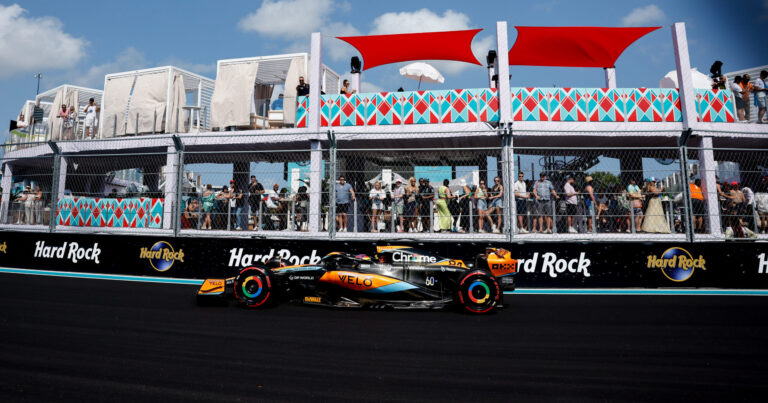

For five weeks this April, the Formula 1 paddock went quiet. Bahrain and Saudi Arabia were cancelled, no replacements were added, and the calendar opened up into the longest mid-season gap in recent memory.
For those of us who live inside the sport, the silence was unusual. For brands, it was a useful reminder. Even the biggest motorsport property in the world is, in the end, one property — and a marketing plan built entirely around it inherits that dependency.
The good news is that the wider motorsport ecosystem has rarely been in better shape. MotoGP, Formula E, IndyCar and the WEC are not consolation prizes. Each is a distinct commercial platform with its own audience, its own story, and its own set of reasons to be on a serious marketing plan in 2026, therefore let's look into motorsport sponsorship beyond F1.
MotoGP
The most commercially interesting motorsport property on the market right now. Liberty Media closed its acquisition in 2025 and has begun to unpack an ambitious growth playbook: long-form content, new markets, entertainment-led positioning. Revenue grew 14% last year, attendance crossed 3.66 million, and the sponsor mix is rebalancing away from its traditional automotive-and-lubricants base — opening real whitespace for financial services, enterprise technology and luxury.
The sport's narrative instrument is the rider: physically exposed, openly emotional, unusually articulate. It's the kind of athlete story modern audiences genuinely engage with, and the kind of platform a brand uses to build equity rather than simply display it.

© Olav Tvedt
Formula E
A credible, certified platform for companies whose narrative is tied to sustainability, electrification or urban innovation. The championship is the only one in motorsport to have been net-zero certified since inception, with ESG credentials that are auditable rather than merely asserted.
The races happen in city centres — London, Berlin, São Paulo, Tokyo, Miami, Monaco — placing the action, and the hospitality, in direct contact with cosmopolitan audiences. The roster tells the story on its own: ABB, Julius Baer, Hankook, Infosys, to name a few. And the quiet commercial value of the E-Village — a B2B room disguised as a race weekend — is among the most underrated assets in motorsport.

© Rico Reynaldi
IndyCar
The most authentic entry point into the American sporting landscape. The Indianapolis 500 sits alongside Monaco and Le Mans as one of the three events at the very top of motorsport, and its cultural roots in the United States go back more than a century.
For European or global brands building US relevance, the commercial arithmetic also lands well: team sponsorships, driver deals and race-day activations are accessibly priced, and the grid leaves real room for non-automotive brands to claim narrative territory of their own. For anyone whose addressable market has a meaningful US component — especially beyond the coasts — IndyCar deserves to be on the table early in the conversation.

© Action Sports
WEC
Endurance racing is having its strongest commercial moment in a generation. Fourteen manufacturers line up in 2026, with Ford and McLaren arriving in 2027 — the deepest premium grid in motorsport, anchored by the 24 Hours of Le Mans.
Two briefs find their natural home here. The first is manufacturer storytelling: any brand in the automotive value chain — tyres, fuels, lubricants, electronics, materials, software — can demonstrate real engineering credibility across races that last 6, 8, 10 or 24 hours. The second is luxury. Le Mans carries a cultural weight that resonates with a premium, high-net-worth audience — watchmaking, private banking, bespoke travel, heritage automotive retail — and as a B2B hospitality product, it sits in a category of its own.

© Xavier Praillet
WRC
Rallying is the most geographically ambitious discipline in motorsport, and arguably the most cinematic. Fourteen rounds across Europe, Africa, South America and Asia — from the Monte Carlo ice to the Safari Rally in Kenya, from Finnish gravel to the tarmac of the Canary Islands — on real roads, in real landscapes, in real weather. WRC global TV audiences have grown by 44% over the past three years, and with Red Bull Media House as co-owner of the commercial rights, the sport's content engine is one of the sharpest in the business.
For brands, the proposition is distinctive on two fronts. The first is terrain: no other championship puts a product through this range of conditions, which is why technical partners — tyres, energy, connectivity, imaging, outerwear — use WRC as a credibility platform that viewers can see working. The second is geography. A WRC sponsorship is one of the few that genuinely reaches emerging and mid-sized markets, from Kenya to Chile to Central Europe, rather than orbiting the same handful of global capitals.

© Jaanus Ree / Red Bull Content Pool
Final Thoughts
For brands whose budgets and objectives match it, F1 remains a remarkably powerful global platform.
But a sophisticated motorsport strategy in 2026 is rarely a single-property strategy. It's a portfolio, and the right portfolio depends on what a brand is genuinely trying to accomplish. The April gap was a reminder that over-concentration on any one property is a commercial risk, not just a scheduling inconvenience.
The brands getting this right are the ones treating motorsport as an ecosystem rather than a single destination — and asking, properly, which series does which job.
Share this on